Tuesday, March 31, 2009
Rain Rain
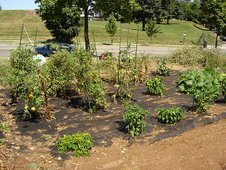
The weather forecast does not look promising for tilling this weekend. Forecasted rain on Wednesday and Thursday will leave my garden to wet for tilling. I have already laid down extra compost and lime two weekends ago. I think I may have missed the March dry "sweet spot" for tilling and planting spring crops.


Monday, February 25, 2008
Lead and Soil Testing
I had always heard that soil-testing was a good idea to improve the overall harvest, but I became motivated to actually do this when I heard that urban gardens may be more suspectible to lead contamination. Although the risk is relatively low, it suddenly seemed like a good idea to actually know what my ph level was because lead contamination is less likely to occur above 6.5 ph.
The University of Minnesota's Extension service has a good article that can be found here.
Lead Contamination and Gardens
University of Ohio Extension Office FAQ
The University of Minnesota's Extension service has a good article that can be found here.
Lead Contamination and Gardens
University of Ohio Extension Office FAQ
DIY grow light system vs kit in small spaces
My master-gardening-mom learned from her classes that a successful grow-light system needs to emit at least 40 watts to give the tiny seedlings the boost they need to grow strong. This new tidbit has finally convinced me that my makeshift system purchased on Saturday at a big box hardware store was not going to work. Thus, I have decided to buy a 2ft ready made kit from Hydro-farm and accept my DIY defeat.
Many garden bloggers have discussed making their own grow light systems using 4ft fluorescent lights, and I have definitely been inspired by their success. However, I live in an apartment and the 4ft fluorescent lights were just too long for my urban dwelling. I had hoped to recreate a similar system with 2ft lights, but I soon realized that there were no plug-in fixtures associated with this size that had the appropriate wattage. After spending several intimidating and vexing hours trying to understand the merits of plug-in versus direct wire lights, I walked away with two, 2 ft, 13 watt plug-in fluorescent lights. After speaking with my mom, I realized that 26 watts were not going to cut it.
So I am going to be a little less thrifty when it comes to my grow-light system. Sometimes living in a smaller space means that the economies of scale from purchasing 10 - 4ft bulbs all at once are just not possible.
The model that I am going to try can be purchased Amazon.com
2ft Hydrofarm Grow light System
Thursday, February 14, 2008
Ordering Seeds
I can't believe that it is February, and I may be a bit behind in my gardening tasks. I just purchased my tomato and pepper seeds yesterday online. I have had really good success with Southern Seed Export and the US distributor of Franchi Sementi seeds, www.growitalian.com. I am going to try growing my tomatoes and peppers from seeds for the first time.
I have received varying advice on when to start. It appears as though one needs to get started anytime between 8-12 weeks before the last frost date. D.C. registers the last frost date as 4/23, but I think I have had more success waiting until May 1st. I still need to buy a light and growing set as I don't have enough natural light to keep them from growing spindly. I hope to have everything set up by February 23rd.
I have received varying advice on when to start. It appears as though one needs to get started anytime between 8-12 weeks before the last frost date. D.C. registers the last frost date as 4/23, but I think I have had more success waiting until May 1st. I still need to buy a light and growing set as I don't have enough natural light to keep them from growing spindly. I hope to have everything set up by February 23rd.
Tuesday, September 4, 2007


Monday, August 20, 2007
An ode to southern vegetables
There are times when I wish DC was a bit further north. A little less burning sun might prevent my tomatoes from dropping their fruit when they get too hot (see explanation under Chicago Gardener) and might just convince my eggplants that they didn't need to put all the energy into producing leaves.
The hot humid August days do make DC a suitable climate for growing butter beans and okra. I didn't grow up regularly eating these tasty delights. I do have a vivid memory of having okra soup on a plane ride between Atlanta and Orlando at age 5. It was probably the only memorable plan meal I have ever eaten. I don't think I had ever tasted butter beans until I moved to DC five years ago. I'm not quite sure how those Southerns keep butter beans a secret. Perhaps, we northerners were cleverly duped into avoiding them under their the "nom de plume du nord" "lima beans". Homegrown butter aka lima beans are just sublime, and one soon forgets the annoyance of husking after a couple bites.
Is the butter bean a lima bean?
Ask wiki
The first and official butterbean festival says ...
Sunday, August 12, 2007


Friday, July 27, 2007
My tomato broke in half
When one of my indeterminate tomatoes broke in half the other day , I did feel my heart break a bit as well. For everyone's sake, I am trying to refrain from writing especially cliche titles for my blog posts. Thus, the comparisons between my broken tomato and heart will end here.
However, I do know that I have gone two season with lack luster success keeping my tomatoes from collapsing under their own weight. I used tomato cages last year, and they were pretty much lying horizontal by early October. I staked my tomatoes to three closely stake bamboo poles this spring and pruned excessively. Alas, I still arrived at my garden with my tomatoes and bamboo poles lying horizontal on the ground. It probably does not help that I have a very sandy soil. Not much more needs to be said about sand as a foolish foundation. However, I did find a link to some Master Gardeners in California who went on a quest to find the best wait to keep tomatoes upright and strong.
http://www.mastergardeners.org/picks/tomato_staking.html
I am inspired to try the square wooden cage option. It has the most advantages and is a good excuse to get my own drill :)
Tuesday, July 24, 2007
Hungarian Cucumber Salad
Last week I had six large cucumbers in my refrigerator and few ideas of what to make other than soup. The recipe below was really tasty, and I was surprised how quickly the cucumbers were used up by this simple recipe. My mom suggested adding onions to the salad next time. It was really refreshing.
HUNGARIAN CUCUMBER SALAD
Joan Nathan's Jewish Holiday Cookbook, 2004
By Joan Nathan
found at Epicurious
HUNGARIAN CUCUMBER SALAD
Joan Nathan's Jewish Holiday Cookbook, 2004
By Joan Nathan
found at Epicurious
Rosemary Ratatouille
My mom tipped me off to the good ratatouille recipe on the Cooking for Engineers blog. I substituted rosemary for basil, and it was delicious. Be sure to add plenty of rosemary early in the cooking process. I think it would also be good with a handful of cannellini beans.
Yummy Ratatouille Recipe via Cooking for Engineers
Yummy Ratatouille Recipe via Cooking for Engineers
dry dry days
I watered my garden three times last week, but it was not enough. My bush beans have dried out, and the cucumbers are barely hanging on. The only plants that appear to thrive in the drought are the banana peppers and sweet potatoes. My neighbor told me that I need to work harder because I am at the top of the hill. Alternatively, I could pick a plot without a slope next spring. I think I am going to choose the later option even if it means no winter garden of garlic leeks and onions.
There are plenty of tomatoes right now. I finally bit into my zebra, pear, and big boy tomatoes. I am loosing faith that the brandywine are going to bloom. To my surprise, one of my eggplants has risen from the dead in the past two weeks. I am off to water again tonight.
There are plenty of tomatoes right now. I finally bit into my zebra, pear, and big boy tomatoes. I am loosing faith that the brandywine are going to bloom. To my surprise, one of my eggplants has risen from the dead in the past two weeks. I am off to water again tonight.
Friday, July 13, 2007
First batch of Spaghetti Sauce
Enough roma tomatoes have ripened that I was able to make my first batch of spaghetti sauce on July 11th. The not-so-secret ingredient to my sauce is carrots, and I did have a few smaller carrots ready from my garden. The homegrown garlic, onions, oregano, basil and garlic made their way into the pot as well. I forgot that garden carrots are especially sweet, so I may need to use fewer in the next batch to make it a little less sweet next time around.
I am looking forward to many more tasty tomato dishes in the coming weeks :)
I am looking forward to many more tasty tomato dishes in the coming weeks :)
Monday, July 2, 2007
New Zealand Spinach salad
I had my first full grown New Zealand spinach salad with goat cheese and a dash of aged balsamic vinegar last night. The spinach is tasty, but has a thicker texture that the normal bloomsdale spinach. I had never heard of the green until I tried to figure out why my regular spinach bolted last year. Alas, DC is far to hot for regular spinach, but local gardeners recommened New Zealand Spinach and Malabar as a close subsitute.
Capatain Cook brought back the near-spinach plant, genus Tetragonia, to London after the 1770 expedition. It remains a staple of Maori cooking, and it is well suited to warm moist climates. Although DC only purports to the first adjective, my plants have come in well. One can learn more about the plant at the following links below. Although I was a bit disturbed that the Wikipedia entry suggested that one needed to blanch the veggies to get rid of mild toxins, none of the other resources intruct this, and I still feel find this morning.
Wikipedia's "New Zealand Spinach"
University of Florida's Extension Office on "New Zealand Spinach"
Garden Guide's "New Zealand Spinach"
Sunday, July 1, 2007
Cucumber Mint soup
I have bagged four cucumbers since I came back to DC on Wednesday. My one plant is spreading its vines and sprouting blossoms at a very rapid pace, so I am expecting more soon. Given the plethora of cucumbers coming my way, I was pleasantly surprised to learn how many variations on cucumber soup were flittering out there in the foodie sphere. My first cool cucumber soup of the year comes from the Epicurious recipe below. My neighbor offered some fresh mint to mix as well. I would not have thought to add an egg, ever, to cucumber soup, but it was simply lovely
COLD CUCUMBER SOUP WITH MINT
Gourmet, July 1996 (found with Epicurious)
Some of the comments indicate that the soup needed peppers to add a bit of heat. With homegrown cukes, I think it is best to just keep the recipe as is.
COLD CUCUMBER SOUP WITH MINT
Gourmet, July 1996 (found with Epicurious)
Some of the comments indicate that the soup needed peppers to add a bit of heat. With homegrown cukes, I think it is best to just keep the recipe as is.
Thursday, June 28, 2007
Cucumbers, cherry tomatoes, and zucchini are here
I spent a week away from DC, and mother nature did not provide a drop of rain during my absence. I was sure that my plants would shrivel and turn a faint yellowish hue in the 90 degree heat. Some indeed did. A few zucchini plants would crumble with the faintest touch. However, my cucumber plant grew about 2 feet and produced two rather large cucumbers in steamy conditions. One shriveled zucchini plant did put forth a nice four inch zucchini. I also had my first cherry tomato last night. My cherry tomato plant seems so small compared to my memories of an overgrown August cherry tomato plant. We'll see what it can produce in the next two months.
Blessed Beets arrive
Their scarlet color may stain your countertops. Their bulbous shape is not the easiest to peel. These challenges are easily forgotten once the cooking begins. It is the season of beets, and I am in bliss.
I planted a short row of beets in April, and I now have about 10 small to medium sized beets ready to be roasted beets. The beets are smaller than those that show up in the store, so one needs a few more beets to fill out beet recipes. I sauteed three last night with carrots and homegrown onions for a delicious beet soup. There are so many recipes to choose; I only wished I had grown more beets earlier in the spring. I planted many more in May and early June, but I am not sure if it will be too hot for them to grow. Rather than worry, I will simply hope for more blessed beets.
Other love letters to beets
NPR's Kitchen Window "The Beet goes on"
Eat Local Challenge "And the beet goes on"
About.com: Greek food "And the beet goes on"
Penn State University (recipes and gardening tips "And the beet goes on"
...and thousands more with the same title. Let this be a lesson that your creative play on word may not be as unique as you thought...
Monday, June 25, 2007
Book Review: Animal, Miracle, Plant
Many individuals look for the "grown locally" sign at their grocery store and frequent the weekend food markets to support local agriculture. The desire to eat the tastiest tomato, cut down on the food miles it takes to grown one's food, and support the livelihoods of neighboring farmers drive the buy local movement. Babara Kingsolver and her family took this initiative a bit further when they decided to move full-time to a Virginian farm where much, if not most, of the locally obtained food could be obtained from their backyard and through their labors. Her description of planting, weeding and harvesting showcase the crisp naturalist prose for which Kingsolver has received much acclaim. She is also at her best when she frames the scale of labor and the timing of the farming year. I did not welcome a lot of the agri-business op-eds that largely equated big as bad and small as good. I didn't necessarily disagree with their arguments, but they failed to cite statistics and references to back up their cases. I would still recommend the book to any vegetable gardener for the recipes, garden humor, and celebration of growing one's own food.
Tuesday, June 19, 2007
Zebra tomatoes almost here; Eggplant has arrived
The heat index will hit in 98 degrees today, and even my colleagues look a bit wilted. I watered my garden around 6:30am to give my plants a good drink before the hot day was too much underway. The plants that had been thinned this weekend looked pretty sturdy and happy to have more space to grow. I don't know how I missed it this weekend, but one of my ichiban eggplants had grown four inches long. I have 3 or 4 zebra tomatoes that are about 3 inches in diameter and the correct color. There are numerous green romas of appropriate size that still need to ripen My peppers are just beginning to flower. Although others are eating their zucchinis, I simply have blossoms at this point.
Sunday, June 17, 2007
Recipe: Cream of Chard and Beet Greens
With the arrival of fresh garlic in my garden, I find myself sauteing garlic, onions, olive oil and the vegetable du jour every night. Although I could continue this pattern until the garlic runs out, I thought I should try something different. I decided to make a cream of chard and beet green recipe from the common ingredients found in a cream of spinach recipe. It was heavenly.
Recipe
2 Tbsp of butter
2 Tbsp of flour
2 small shallots (courtesy of my garden)
1 cup of skim milk
a big bunch of Swiss chard stemmed
a good handful of baby beet greens
1/8 cup of grated fresh Parmesan cheese
salt, pepper and nutmeg to taste
I simply melted the butter over medium heat and then sauteed the shallots for a minute or two. I then sprinkled in the flour while stirring vigorously with a silicon spatula. Once the mixture was smooth and bubbling, I added the milk and greens. The greens begin to wilt as the milk heats up. I grated the cheese and nutmeg directly onto the mixture when greens the had cooked down and the sauce was thickening.
Subscribe to:
Posts (Atom)