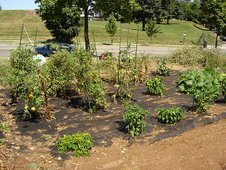
My rows of beans, carrots and beets that were planted on 5/20 have yet to break free from the soil. This is not a good sign. It usually does not take three weeks to germinate. I have tried to delude myself that some weeds were actually beans, but I know that the weeds will look even more like weeds and less like vegetables when I return to my garden on Friday. In addition to a healthy does of denial, I am still trying to figure out what I did wrong. Either I planted the seeds too deeply and they didn't have enough energy to make it to the surface, or I planted them to shallow and the heavy rains washed away the seeds. It is also possible that the seeds didn't receive enough moisture during germination. There is also option "d", none of the above.
I think we are usually conditioned to think that we can learn from experience. However, gardening regularly challenges this thought. After many springs, one might have a better grasp, but there are so many things that are just unknown to the novice. Although frustrating, it is probably good that I can't research out the answer or test my hypothesis. Instead, I can simply shrug my shoulders and plant again on Friday.
Showing posts with label What a garden can teach. Show all posts
Showing posts with label What a garden can teach. Show all posts
Monday, June 4, 2007


Thursday, May 31, 2007
Reflections on Gardening and Politics
And he gave it for his opinion, that whoever could make two ears of corn, or two blades of grass, to grow upon a spot of ground where only one grew before, would deserve better of mankind, and do more essential service to his country, than the whole race of politicians put together.
- Jonathan Swift, Gulliver's Travels
"No occupation is so delightful to me as the culture of the earth,no culture comparable to that of the garden ... But though an old man, I am but a young gardener."
- Thomas Jefferson
"The greatest service which can be rendered any country is to add a useful plant to its culture."
- Thomas Jefferson
Tuesday, May 29, 2007
How fine are your garden rows?
"There is a quality even meaner than outright ugliness or disorder, and this meaner quality is the dishonest mask of pretended order, achieved by ignoring or suppressing the real order that is struggling to exist and to be served." - Jane Jacobs
Many of my community garden neighbors have praised the look of my garden this spring. They say that it is a "fine looking garden" and that I am "tending to it well." Most of the elderly gentlemen gardeners simply walk over and nod approvingly without any unnecessary comments. We both know that my garden looks neat.
I have a nice square of onions with towering green stems and smart, short rows of root vegetables and greens. My rows are labeled with markers, and I have moved systematically each weekend toward my manifest destiny of sowing seeds to the western boundary of the garden plot. I have order in my garden, and there is wide recognition that this is a good quality. As long as I continue the long war against the weeds, my garden would look smart for the rest of the summer. I would always leave my garden with dirt-stained knees and sweat and soil mixed across my brow, but my garden would be neat.
The quality of messiness spread from the gardener to the garden last Saturday after a successful trip to the farmer's market. I found the healthy looking zucchini plants that I had heretofore not found. I also saw a sweet potato plant and wondered what it might be like to eat a homemade sweet potato pie from home grown sweet potatoes. Knowing that the answer would most likely be "heavenly," I purchased the zucchini and sweet potato plants and tried my best to find them new homes in my well-packed garden. After surveying the grounds, I plopped a zucchini plant in my onion patch and snuggled a sweet potato plant amidst my beans. Another zucchini plant found its home amongst the radishes. My rows still look neat, but the vines of the new plants will soon sketch new angles and disrupt the sharp parallel lines that had defined my garden. The green leaves of differing plants will become tangled, and the row markers will not point directly to the crop they once announced proudly.
My experiment in polyculture may fail, and I am willing to entertain complaints that some of these roots crops probably would do better without the competition of another plant in such close vicinity. Yet, the rebel in me who suffered through boring and tragic tomes of failed monoculture extension efforts in developing countries, decided that a little bit of polyculture may be just what my garden needed. And thus, the beans and onions will make room. The radishes will soon be gone, but their former home will not lay vacant. I will loose a bit of crawling space, but my knees will undoubtedly remain covered in dirt after gardening. And maybe, just maybe, new growth will flourish in a less tidy space with a less tidy look. If my young sweet potato plant lead to pies and budding zucchinis lead to chocolate quick bread, I will not grieve the praise I would have received if I had stuck to a more cartesian layout. Messiness will bring other rewards.
Subscribe to:
Posts (Atom)